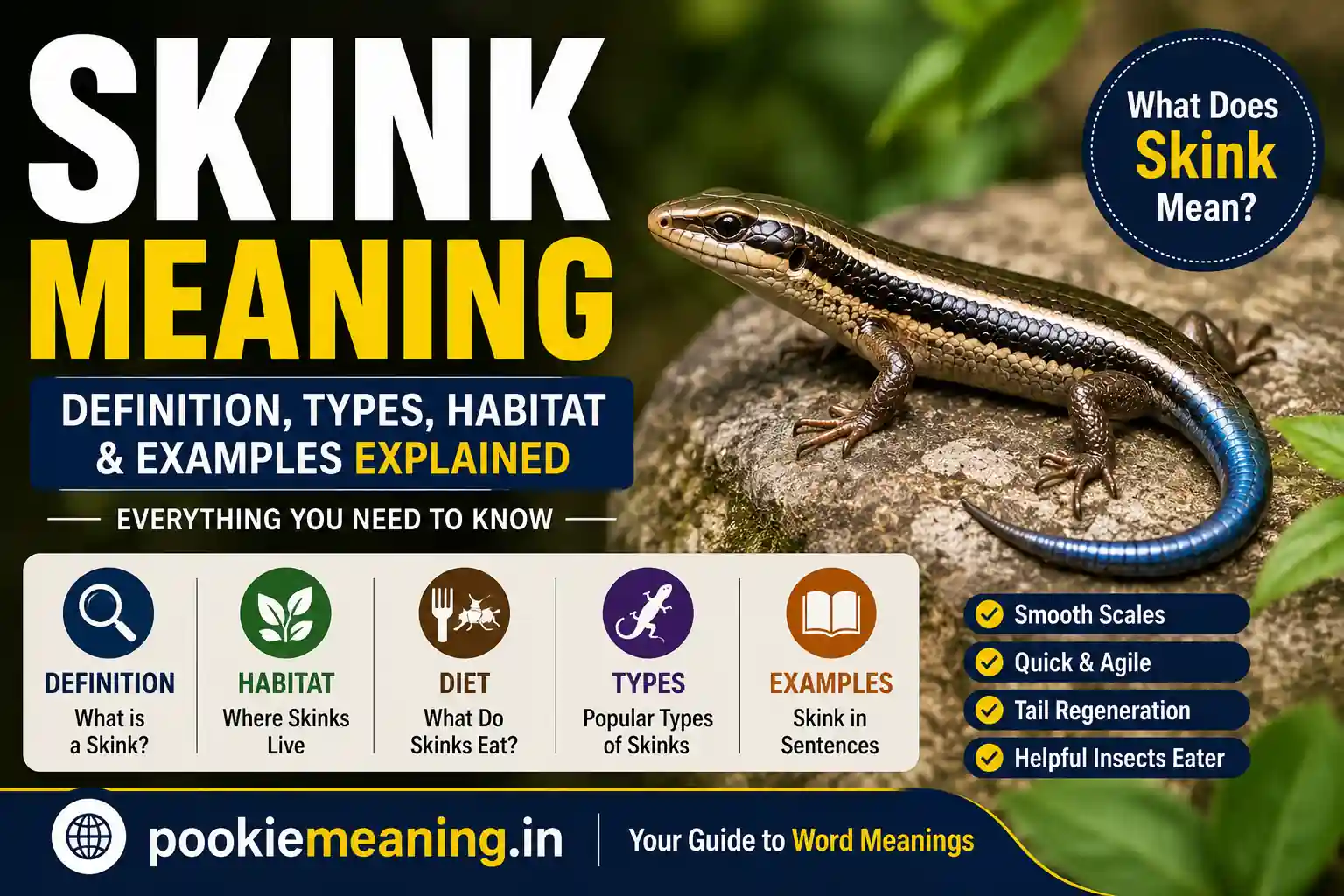
If you have ever seen a small, shiny lizard quickly disappearing into grass or under rocks, there’s a good chance it was a skink. While the word may sound unusual, skinks are among the most common reptiles found around the world.
A skink is a type of lizard belonging to the family Scincidae. These reptiles are known for their smooth scales, slender bodies, and quick movements.
In simple terms:
A skink is a small to medium-sized lizard that lives in forests, deserts, grasslands, and even gardens.
📖 Read Also: Herpetology Meaning
Skink Meaning in English
The word Skink refers to:
A member of the lizard family Scincidae, characterized by smooth scales, short legs, and a streamlined body.
Skinks are found on almost every continent except Antarctica.
Pronunciation of Skink
Skink is pronounced as:
SKINK
Phonetic pronunciation:
/skɪŋk/
The word rhymes with “think” and “blink.”
What Does a Skink Look Like?
Most skinks have:
- Smooth, shiny scales
- Long bodies
- Small legs
- Pointed heads
- Long tails
Some species even resemble snakes because their legs are extremely small.
One interesting feature is that many skinks can detach their tails to escape predators and later grow them back.
📖 Read Also: Vulpine Meaning
Origin of the Word Skink
The word Skink comes from older European languages that were used to describe certain reptiles.
Over time, zoologists adopted the term to identify members of the Scincidae family.
Today, “skink” is the standard scientific and common name used worldwide.
Where Do Skinks Live?
Skinks are highly adaptable animals and can live in various environments:
Forests
Many species thrive in tropical and subtropical forests.
Grasslands
Some skinks prefer open grassy areas with plenty of hiding spots.
Deserts
Several species have adapted to hot, dry climates.
Gardens and Urban Areas
In many countries, skinks are commonly seen in backyards and parks.
What Do Skinks Eat?
Most skinks are insectivores, meaning they primarily eat insects.
Their diet may include:
- Ants
- Beetles
- Crickets
- Spiders
- Worms
Some larger species may also consume fruits, plants, or small animals.
📖 Read Also: Tyrannosaurus Meaning
Examples of Skink in Sentences
Here are a few simple examples:
- A skink darted across the garden and disappeared under a rock.
- Scientists discovered a new species of skink in the rainforest.
- The skink used its tail as a defense mechanism.
- Children observed a skink during their nature walk.
- Many skinks help control insect populations naturally.
Types of Skinks
There are more than 1,500 known species of skinks worldwide.
Popular examples include:
- Blue-Tongued Skink
- Fire Skink
- Five-Lined Skink
- Solomon Island Skink
- Sand Skink
Each species has unique colors, sizes, and behaviors.
Why Are Skinks Important?
Skinks play an important role in ecosystems because they:
- Control insect populations
- Serve as prey for larger animals
- Help maintain ecological balance
- Indicate environmental health
Because they feed on pests, many gardeners consider them beneficial reptiles.
Fun Facts About Skinks
- Some skinks have bright blue tongues.
- Certain species can live for over 20 years.
- Many skinks can regrow their tails.
- They are among the most diverse lizard families on Earth.
- Some species give birth to live young instead of laying eggs.
FAQs
What is the meaning of Skink?
A skink is a type of lizard belonging to the family Scincidae.
Is a skink a snake?
No. Although some skinks look similar to snakes, they are actually lizards.
Where are skinks found?
Skinks live in forests, deserts, grasslands, gardens, and many other habitats around the world.
What do skinks eat?
Most skinks eat insects such as ants, beetles, spiders, and crickets.
Are skinks dangerous to humans?
No. Most skinks are harmless and generally avoid human contact.