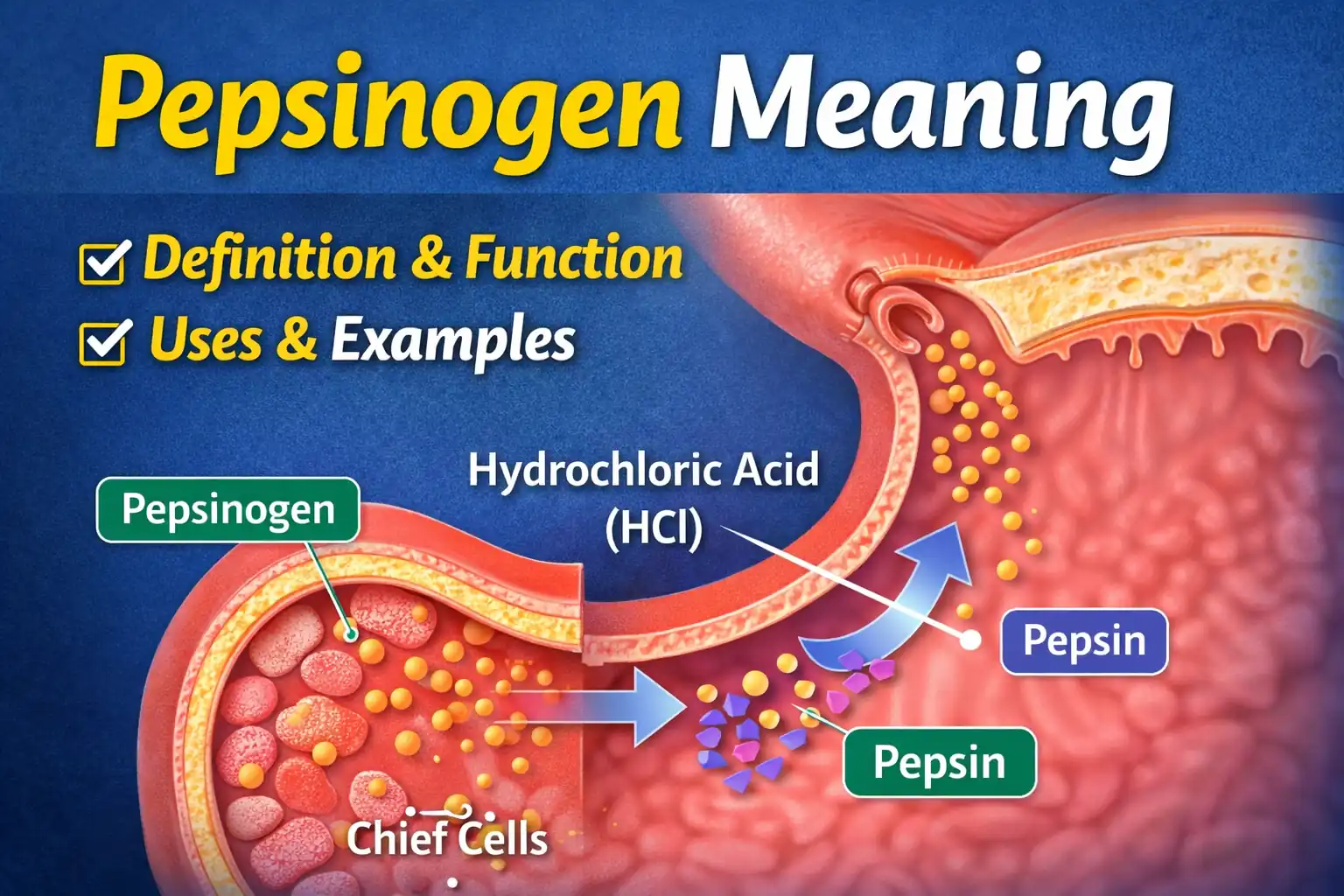
The term Pepsinogen Meaning is commonly used in biology and medical science. It refers to an inactive enzyme that plays a crucial role in the human digestive system. Although the word may sound complex, its concept is quite easy to understand.
In simple terms, pepsinogen is an inactive form of the enzyme pepsin, which helps break down proteins in the stomach.
What is Pepsinogen Meaning?
The Pepsinogen Meaning can be defined as:
👉 “Pepsinogen is an inactive enzyme (zymogen) produced by the stomach lining that converts into pepsin to digest proteins.”
It is secreted by special cells in the stomach known as chief cells.
How Pepsinogen Works
Understanding the working of pepsinogen helps you better understand the Pepsinogen Meaning.
- Pepsinogen is released into the stomach.
- It comes in contact with hydrochloric acid (HCl).
- The acid converts pepsinogen into pepsin.
- Pepsin then breaks down proteins into smaller molecules.
This process is very important for proper digestion.
Why is Pepsinogen Important?
The Pepsinogen Meaning is important because:
- It helps in protein digestion
- It protects the stomach from self-damage
- It ensures enzymes activate only when needed
If pepsinogen were active from the beginning, it could damage the stomach lining. That is why it is released in an inactive form.
Pepsinogen in Simple Words
To understand Pepsinogen Meaning easily:
- Pepsinogen = inactive enzyme
- Pepsin = active enzyme
- Function = break down proteins
So, pepsinogen is like a “sleeping enzyme” that becomes active when required.
Examples of Pepsinogen Function
Here are some real-life examples:
- When you eat food like eggs or meat, pepsin helps digest protein.
- Pepsinogen activates only in the stomach due to acid.
- Doctors may test pepsinogen levels to check stomach health.
These examples show how the Pepsinogen Meaning is connected to everyday digestion.
Medical Importance of Pepsinogen
In medical science, Pepsinogen Meaning is very important:
- It is used as a marker for stomach diseases
- Low levels may indicate gastric problems
- High levels may be linked to ulcers
Doctors often use pepsinogen tests to understand stomach conditions better.
Types of Pepsinogen
There are mainly two types:
- Pepsinogen I – Found in the main part of the stomach
- Pepsinogen II – Found in both stomach and upper intestine
Both types help doctors diagnose various health issues.
Difference Between Pepsinogen and Pepsin
| Feature | Pepsinogen | Pepsin |
|---|---|---|
| Type | Inactive enzyme | Active enzyme |
| Function | Gets activated | Digests proteins |
| Location | Stomach lining | Stomach |
This comparison makes the Pepsinogen Meaning clearer.
Conclusion
The Pepsinogen Meaning is an important concept in biology and health science. It refers to an inactive enzyme that plays a key role in protein digestion after being converted into pepsin.
Understanding this term helps you learn how your digestive system works and why enzymes are important. Even though it sounds technical, the idea is simple: pepsinogen is the starting point of protein digestion in the stomach.
FAQs (Yoast Compatible Format)
1. What is pepsinogen meaning in simple words?
Pepsinogen is an inactive enzyme that becomes pepsin to digest proteins in the stomach.
2. Where is pepsinogen produced?
It is produced in the stomach lining by chief cells.
3. What converts pepsinogen into pepsin?
Hydrochloric acid (HCl) in the stomach converts it into pepsin.
4. Why is pepsinogen inactive?
It is inactive to protect the stomach from damage.
5. What is the function of pepsinogen?
Its main function is to help in protein digestion after activation.