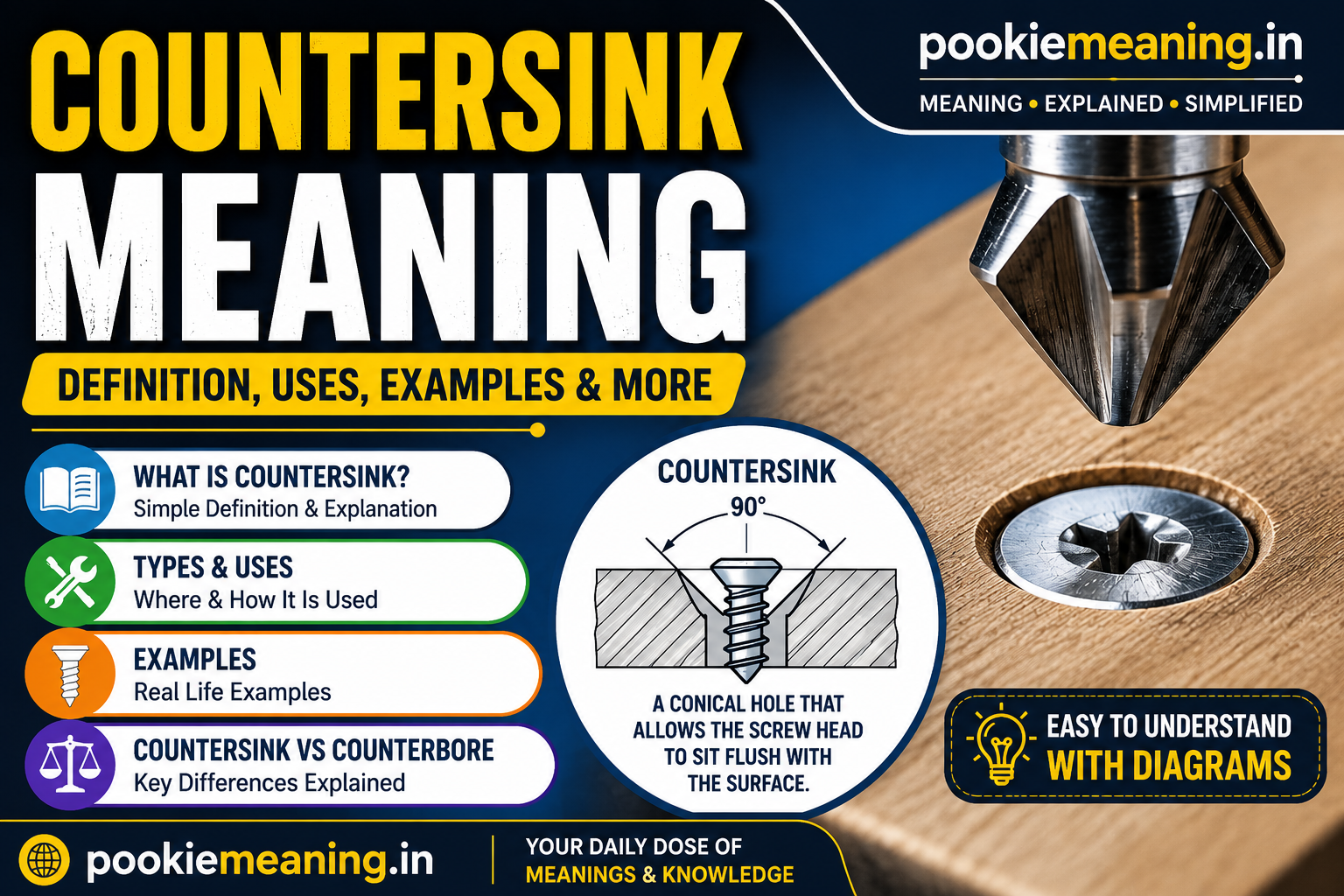
If you’ve come across the word countersink while reading about woodworking, engineering, construction, or DIY projects, you may wonder what it actually means. In simple terms, a countersink is a conical hole cut into a material so that the head of a screw sits flush with or below the surface.
Unlike a normal drilled hole, a countersunk hole has an angled opening that matches the shape of flat-head screws. This creates a cleaner finish and helps prevent the screw head from sticking out.
If you enjoy learning the meanings of technical English words, you may also like Stalactite Meaning, which explains another commonly searched term.
Countersink Meaning in Simple English
Countersink (noun):
A cone-shaped recess made around a drilled hole so the head of a flat screw fits neatly inside.
Countersink (verb):
To cut or create this cone-shaped recess before inserting the screw.
Easy Definition
Countersink means creating a sloped opening in a hole so that a screw fits flush with the material’s surface.
Pronunciation
Countersink
Pronounced: KOWN-ter-singk
Countersink Meaning in Hindi
Countersink Meaning in Hindi: शंकु आकार का गड्ढा बनाना, जिससे स्क्रू का सिरा सतह के बराबर बैठ जाए।
Why Is a Countersink Used?
A countersink provides several advantages:
- Makes the surface smooth
- Prevents screw heads from sticking out
- Improves appearance
- Reduces chances of injury from exposed screws
- Helps furniture and machine parts fit together properly
Where Is Countersink Used?
You’ll commonly find countersinks in:
- Woodworking
- Furniture making
- Metal fabrication
- Engineering
- Construction
- Aircraft manufacturing
- Home DIY projects
Example Sentences
- Please countersink the hole before installing the screw.
- The carpenter used a countersink bit to create a smooth finish.
- This metal plate requires a countersunk screw.
- Always countersink hardwood before inserting flat-head screws.
Countersink vs Counterbore
| Feature | Countersink | Counterbore |
|---|---|---|
| Shape | Cone-shaped | Flat-bottom cylindrical |
| Used For | Flat-head screws | Hex bolts and socket-head screws |
| Appearance | Angled hole | Straight recess |
| Finish | Flush surface | Recessed bolt head |
Many people searching for engineering terminology also explore words like Flume Meaning to expand their technical vocabulary.
Types of Countersinks
1. Standard Countersink
Used for most woodworking and metal applications.
2. Single-Flute Countersink
Produces smooth cuts with less chatter.
3. Multi-Flute Countersink
Ideal for harder metals and professional machining.
4. Countersink Drill Bit
Combines drilling and countersinking in one tool.
Advantages of Countersinking
- Professional finish
- Better screw alignment
- Prevents material damage
- Improves durability
- Reduces snagging on surfaces
- Safer to touch
Disadvantages
- Takes additional drilling time
- Requires a countersink bit
- Over-countersinking may weaken the material
Synonyms
- Recess
- Chamfer
- Bevel hole
- Screw recess
Related Terms
- Counterbore
- Chamfer
- Drill Bit
- Pilot Hole
- Fastener
- Flat Head Screw
Frequently Asked Questions
What does countersink mean?
It means creating a cone-shaped recess so a screw sits flush with the surface.
Is countersink a tool?
It can refer to both the cutting tool and the finished conical hole.
Where is a countersink used?
It is widely used in woodworking, metalworking, engineering, and construction.
What angle is a countersink?
Most countersinks are 82° or 90°, depending on regional standards.
What is the difference between countersink and counterbore?
A countersink creates an angled recess, while a counterbore creates a flat-bottom recess.